Beyond Cold Data: How to Evaluate Technologies Without Falling into the PoC Trap
Beyond Cold Data: How to Evaluate Technologies Without Falling into the PoC Trap
Designing technology solutions that meet business demands requires balancing functional requirements, technical constraints, and the available technology portfolio. In a fast-moving enterprise landscape, seeking out new tools is inevitable. To mitigate risks and avoid decisions based purely on guesswork, the industry has standardized around a familiar ritual: the Proof of Concept (PoC).
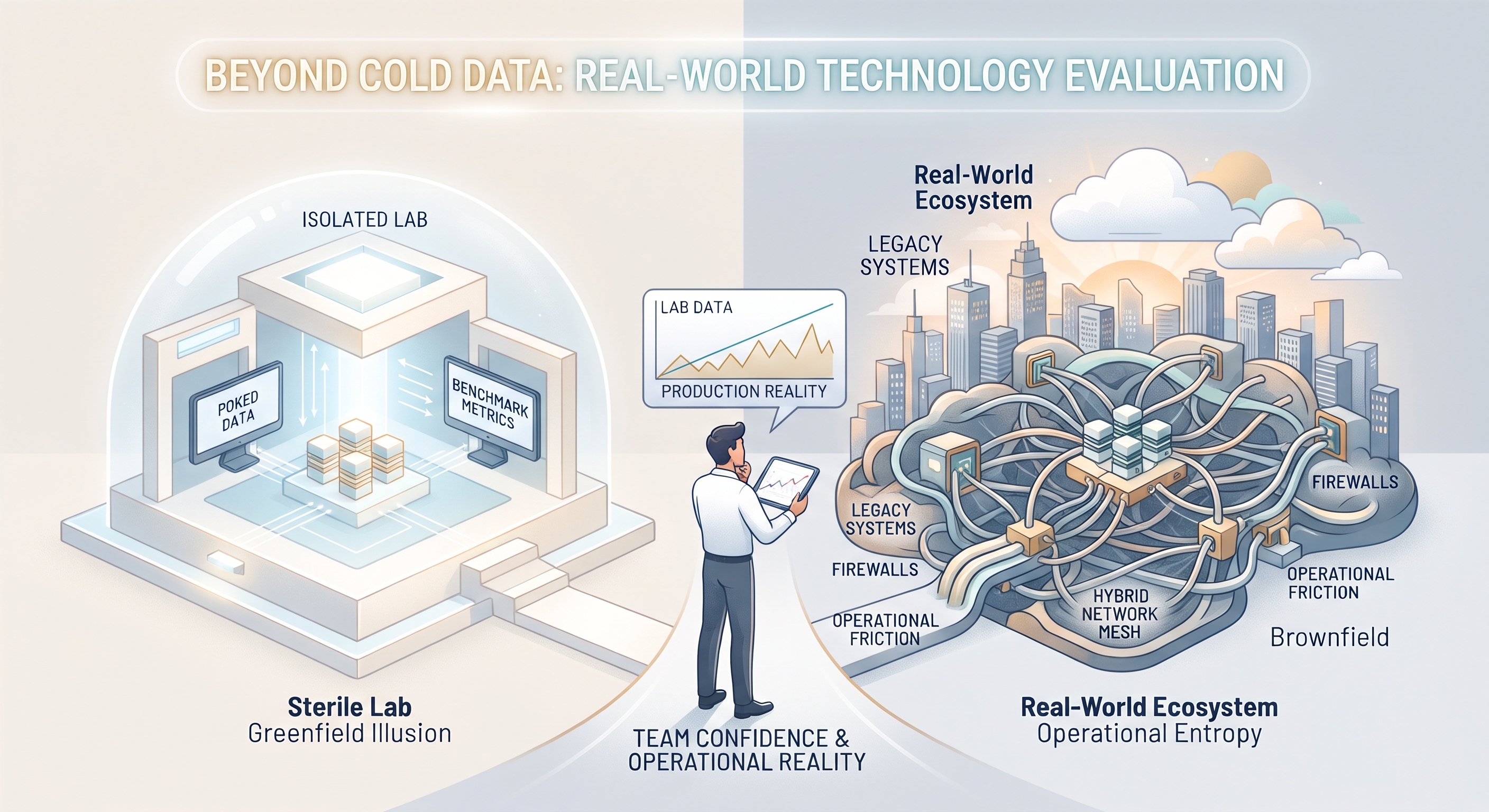
The problem is that when we evaluate a technology by looking exclusively at data and facts gathered in a lab, we create a dangerous evaluation gap. Benchmark spreadsheets and feature checklists prove that a tool works, yet they fail to uncover hidden risks, operational friction, and the level of confidence that the technology inspires in the technical teams who will actually sustain it.
The Trap of the “Greenfield Illusion”
The traditional PoC was born with a noble goal: validating the feasibility of a solution on a small scale, with clear success metrics, before committing a larger budget. Without concrete evidence, decisions fall back on personal opinions and human biases.
However, in large-scale enterprise architectures, a PoC can become a major Achilles’ heel. It often creates a “greenfield illusion”: the solution performs flawlessly inside a sterile lab, completely insulated from the gravity and complexity of the company’s real-world ecosystem.
This synthetic scenario fails to capture operational friction primarily due to three structural flaws:
- Integration Isolation (Brownfield): The technology is validated out of context, ignoring the friction of connecting it to legacy systems, hybrid network meshes, restrictive firewalls, and heavily customized enterprise identity providers.
- Day 0/1 Tunnel Focus (Underestimating “Day-2 Operations”): Most evaluations only prove that a tool can be provisioned and configured. The real cost hides in Day 2: how the solution behaves under stress, how it integrates into existing workflows, its impact on governance, and the learning curve for the operations and support teams.
- Security and Compliance False Positives: To speed up PoC sign-off, security policies are frequently bypassed or relaxed in the lab environment. When the solution attempts to move into production under the full rigor of definitive policies—especially in heavily regulated industries—the architecture breaks or the deployment stalls.
The Factor Benchmarks Ignore: Team Confidence
It is precisely in this vacuum between the lab and production that the perception of technical teams lives. Often, a tool hits 100% of the PoC’s technical criteria, yet meets quiet resistance from platform, network, or operations engineers.
This resistance is rarely mere attachment to legacy systems; in practice, it acts as a barometer for operational risk. When a technical team lacks confidence in a technology, they are signaling friction points that synthetic data failed to capture:
- shallow or incomplete documentation;
- opaque troubleshooting in failure scenarios;
- an immature ecosystem; or
- a cognitive load incompatible with day-to-day operations.
Dismissing this perception for the sake of a spotless PoC report simply transfers the risk of the evaluation directly to the 3:00 AM on-call shift.
From PoC to the Real World: Reality-Anchored Strategies
To avoid this trap, our architectural approach must evolve from a PoC (Proof of Concept)—which proves something is possible—to a PoV (Proof of Value) or continuous pilot models, which prove the solution can survive in the real world. This requires shifting the focus of the evaluation:
- Non-Functional Requirements (NFRs) at the Core: An evaluation should not just be a feature checkbox exercise. The heaviest weight must rest on NFRs: does the solution integrate natively with our IaC pipelines (Terraform/Ansible)? What is the real latency overhead? Do the generated logs and metrics make sense within our current observability stack?
- Vertical Slice Deployment: Instead of testing every feature of a technology in an empty sandbox, pick a real, low-risk workload—such as a peripheral microservice—and push that technology through the entire corporate delivery pipeline: CI/CD, vulnerability scanning, change approvals, and production monitoring.
- Shadow Traffic Testing: Whenever possible, mirror a fraction of real traffic or workloads (properly anonymized) to the environment where the technology is being evaluated. This exposes concurrency behaviors and performance bottlenecks that synthetic data could never replicate.
Conclusion
Data and facts are indispensable for eliminating guesswork, but they do not replace the critical judgment of the people who will operate the environment day in and day out. Accepting that no lab environment can perfectly replicate the entropy of production—and listening to the confidence level of your technical teams—is the first step toward designing architectures that do not turn into a million-dollar technical debt the following year.